
12th Physics Electrostatics
Prepare for the Tamil Nadu 12th Physics Public Examination with carefully selected Chapter 1 – Electrostatics Important 5 Mark Questions. These chapter-wise questions are compiled from the last six years of 1st Mid-Term, Quarterly, 2nd Mid-Term, Half-Yearly, Revision Exam 1, Revision Exam 2, and Tamil Nadu Public Examination question papers.
01
Chapter Number
5 Marks
50+ Question Papers
TN Board
Latest Syllabus
Most Repeated 5 Mark Questions
Curated from Previous Year Question Papers
1.Electric field due to a dipole along Axial line ?(6)
Consider an electric dipole placed on the x-axis, A point C is located at a distance of r from the midpoint O of the dipole on the axial line
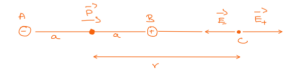

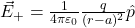







If the point C is very far away from the dipole (r >> a)}
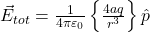

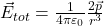
It is important to note that the energy density depends only on the electric field and not on the size of the plates of the If the point C is chosen on the left side of the dipole, the total electric field is still in the direction of p vetor.
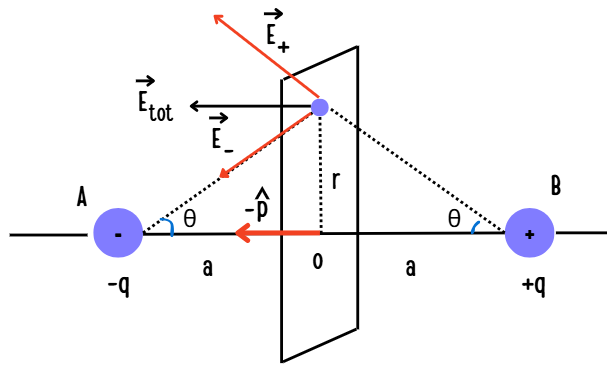
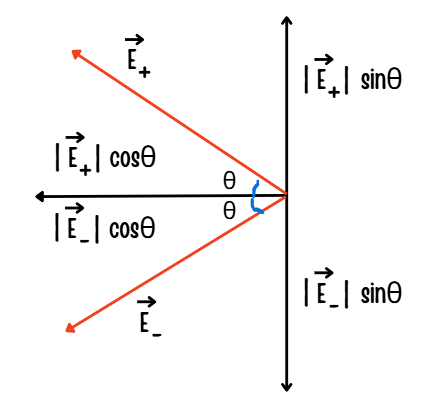
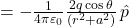
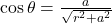
2.Electric field due to a dipole at a point on the Equatorial plane ?(2)
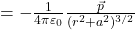
Consider a point C at a distance r from the midpoint O of the dipole on the equatorial plane








3.Explain the working of Van de Graaff Generator (5)
- Robert Van de Graaff designed a machine which produces a large amount of electrostatic potential difference, up to several million volts (107 V).
- This Van de Graff generator works on the principle of electrostatic induction and action at points.
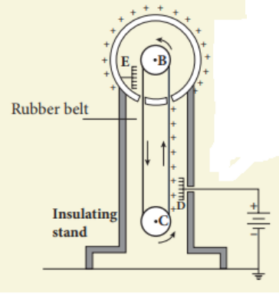
Construction :
- A large hollow spherical conductor is fixed on the insulating stand.
- A pulley B is mounted at the centre of the hollow sphere and another pulley C is fixed at the bottom.
- A belt made up of insulating materials like silk or rubber runs over both pulleys.
- The pulley C is driven continuously by the electric motor.
- Two comb shaped metallic conductors E and D are fixed near the pulleys.
- The comb D is maintained at a positive potential of 104 V by a power supply.
- The upper comb E is connected to the inner side of the hollow metal sphere.
Working :
- Due to the high electric field near comb D, air between the belt and comb D gets ionized by the action of points.
- The positive charges are pushed towards the belt and negative charges are attracted towards the comb D.
- The positive charges stick to the belt and move up. When the positive charges on the belt reach the point near the comb E, the comb E acquires negative charge and the sphere acquires positive charge due to electrostatic induction.
- As a result, the positive charges are pushed away from the comb E and they reach the outer surface of the sphere. Since the sphere is a conductor, the positive charges are distributed uniformly on the outer surface of the hollow sphere.
- At the same time, the negative charges nullify the positive charges in the belt due to corona discharge before it passes over the pulley.
When the belt descends, it has almost no net charge. At the bottom, it again gains a large positive charge. The belt goes up and delivers the positive charges to the outer surface of the sphere. This process continues until the outer surface produces the potential difference of the order of 107 which is the limiting value. We cannot store charges beyond this limit since the extra charge starts leaking to the surroundings due to ionization of air.
The leakage of charges can be reduced by enclosing the machine in a gas filled steel chamber at very high pressure. The high voltage produced in this Van de Graaff generator is used to accelerate positive ions (protons and deuterons) for nuclear disintegrations and other applications.
4.Electrostatic Potential at a point due to electric dipole (4) (Public Exam 2026)
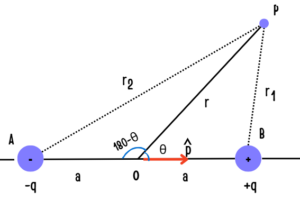
- Consider two equal and opposite charges separated by a small distance 2a.
- The point P is located at a distance r from the midpoint of the dipole.
- Let θ be the angle between the line OP and dipole axis AB
- Let r1 be the distance of point P from +q and r2 be the distance of point P from –q.





![r_1^2 = r^2 \left[ 1 + \frac{a^2}{r^2} - \frac{2a}{r} \cos\theta \right]](https://padidaa.com/wp-content/ql-cache/quicklatex.com-958c0c6a5b145736335cdc4e8a5de29a_l3.png "Rendered by QuickLaTeX.com")

![\therefore r_1^2 = r^2 \left[ 1 - \frac{2a}{r} \cos\theta \right]](https://padidaa.com/wp-content/ql-cache/quicklatex.com-d11c7828cfeb3eed18ddf909bed8b75c_l3.png "Rendered by QuickLaTeX.com")
![r_1 = r \left[ 1 - \frac{2a}{r} \cos\theta \right]^{1/2}](https://padidaa.com/wp-content/ql-cache/quicklatex.com-902bf8521594fbae381073070b67143f_l3.png "Rendered by QuickLaTeX.com")
![\frac{1}{r_1} = \frac{1}{r} \left[ 1 - \frac{2a}{r} \cos\theta \right]^{-1/2}](https://padidaa.com/wp-content/ql-cache/quicklatex.com-455bfea00799476358de9582ffb3efe4_l3.png "Rendered by QuickLaTeX.com")

![\frac{1}{r_1} = \frac{1}{r} \left[ 1 - \left( -\frac{1}{2} \right) \frac{2a}{r} \cos\theta \right]](https://padidaa.com/wp-content/ql-cache/quicklatex.com-7ba1858d3222c0fe5c336009c3ad7540_l3.png "Rendered by QuickLaTeX.com")
![\frac{1}{r_1} = \frac{1}{r} \left[ 1 + \frac{a}{r} \cos\theta \right]](https://padidaa.com/wp-content/ql-cache/quicklatex.com-07043c68a3f38524ac99fec403fdfb48_l3.png "Rendered by QuickLaTeX.com")

![\frac{1}{r_2} = \frac{1}{r} \left[ 1 - \frac{a}{r} \cos\theta \right]](https://padidaa.com/wp-content/ql-cache/quicklatex.com-a47514c61e9897d8b223cd2ba66201ca_l3.png "Rendered by QuickLaTeX.com")
![= \frac{q}{4\pi \varepsilon_0} \left[ \frac{1}{r} \left( 1 + \frac{a}{r} \cos\theta \right) - \frac{1}{r} \left( 1 - \frac{a}{r} \cos\theta \right) \right]](https://padidaa.com/wp-content/ql-cache/quicklatex.com-a17edbc77c2cc9df64ebc6ac2f0f16ce_l3.png "Rendered by QuickLaTeX.com")
![= \frac{q}{4\pi \varepsilon_0} \frac{1}{r} \left[ 1 + \frac{a}{r} \cos\theta - 1 + \frac{a}{r} \cos\theta \right]](https://padidaa.com/wp-content/ql-cache/quicklatex.com-864c7f554487ae2d1f713a411594e906_l3.png "Rendered by QuickLaTeX.com")
![= \frac{q}{4\pi \varepsilon_0} \frac{1}{r} \left[ \frac{2a \cos\theta}{r} \right]](https://padidaa.com/wp-content/ql-cache/quicklatex.com-48084b6ceef1f1207b804ab4ef2d4a9d_l3.png "Rendered by QuickLaTeX.com")
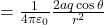




![V = \frac{1}{4\pi \varepsilon_0} \frac{p}{r^2} \quad [\cos\theta = 1]](https://padidaa.com/wp-content/ql-cache/quicklatex.com-8946434ab8981266755926eef41155a3_l3.png "Rendered by QuickLaTeX.com")

![V = - \frac{1}{4\pi \varepsilon_0} \frac{p}{r^2} \quad [\cos 180^\circ = -1]](https://padidaa.com/wp-content/ql-cache/quicklatex.com-14b8540c0ff29a3b7e625756fda2b956_l3.png "Rendered by QuickLaTeX.com")


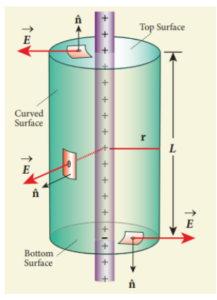
5.Electric field due to an infinitely long charged wire (Applications of Gauss Law) (Public Exam 2025)(4)
- Consider an infinitely long straight wire having uniform linear charge density λ (charge per unit length).
- Let P be a point located at a perpendicular distance r from the wire.
- The electric field at the point P can be found using Gauss law.

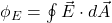







![Q_{enc} = \lambda L \quad [\text{charge density × length}]](https://padidaa.com/wp-content/ql-cache/quicklatex.com-be347d6446af93a1bb1b1fbc36f45707_l3.png "Rendered by QuickLaTeX.com")

![E \cdot 2\pi r L = \frac{\lambda L}{\varepsilon_0} \quad [dA = \text{curved surface area of cylinder}]](https://padidaa.com/wp-content/ql-cache/quicklatex.com-0c31884b8b572a9a28f13f117680fa11_l3.png "Rendered by QuickLaTeX.com")
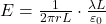


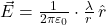

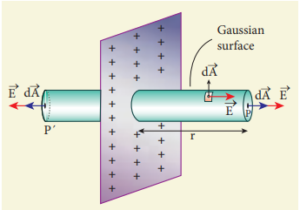
6.Electric field due to charged infinite plane sheet ( Applications of Gauss Law ) (2)
- Consider an infinite plane sheet of charges with uniform surface charge density σ.
- Let P be a point at a distance of r from the sheet



![Q_{enc} = \sigma A \quad [\text{charge density × area}]](https://padidaa.com/wp-content/ql-cache/quicklatex.com-236b62fef0cec5512f3baef29e5425a0_l3.png "Rendered by QuickLaTeX.com")
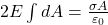


electric field due to an infinite plane sheet of charge depends on the surface charge density and is independent of the distance r.
- if σ > 0 the electric field at any point P is along outward perpendicular n
- if σ < 0, the electric field points inward perpendicularly to the plane (-n ).
What’s Next?
Continue your journey through Lesson 1 – Electrostatics. Master the important Two Mark and Three Mark questions, or explore the complete 12th Physics study guide covering every chapter.
⭐ Why Thousands of Students Choose Padidaa
✔ Carefully Curated Previous Year Questions
✔ Chapter-wise Important 2, 3 & 5 Mark Questions
✔ Book Back Questions with Answers
✔ Public Exam Focused Study Material
✔ Free Online Notes & PDF Downloads
✔ Updated for the Latest Tamil Nadu Board Syllabus
