
12th Zoology / Bio Zoology Important 2, 3, 5 Mark Questions 2026
Chapter 2 : Human Reproduction
Most Repeated Questions
Number next to question tells how many times the question has been repeated in the past few years
TWO MARKS
1.Expand the acronyms.(2)
- a) FSH – Follicular stimulating Hormone
- b) LH – Lutenizing Hormone
- c) hCG – Human Chrionic Gonadotropin
- d) HPL – Human Placental Lactogen
2.What is inhibin? State its functions?(2)
Inhibin is a hormone secreted by Sertoli cells in the seminiferous tubules.
Function: It regulates sperm production by negative feedback control, inhibiting excess spermatogenesis.
3.What is Ectopic pregnancy?(2)
- Ectopic pregnancy is a condition in which the fertilized ovum implants outside the uterus.
- Most commonly occurs in the fallopian tube and may lead to internal bleeding and serious complications.
THREE MARKS
1.Differentiate Spermiogenesis and Spermatogenesis?(3)
| Spermiogenesis | Spermatogenesis |
|---|---|
| Formation of sperms from spermatogonia through mitosis and meiosis | Transformation of spermatids into mature spermatozoa |
| Includes mitotic and meiotic divisions | No cell division, only differentiation |
| Produces primary spermatocytes → secondary spermatocytes → spermatids | Converts spermatids → spermatozoa |
| Complete process of sperm formation | Final stage of spermatogenesis |
| Formation of haploid spermatids | Formation of mature motile sperms |
2.What is Colostrum? Write its significance?(2)
Definition
- Colostrum is a yellowish, nutrient-rich fluid secreted by the mammary glands during the first few days after childbirth.
Significance
- Easily digestible and essential for newborn growth
- Rich in proteins, vitamin A, minerals and IgA antibodies
- Provides immunity and protects against infections
- Acts as a natural antimicrobial agent
- Helps in maturation of the infant’s immune system
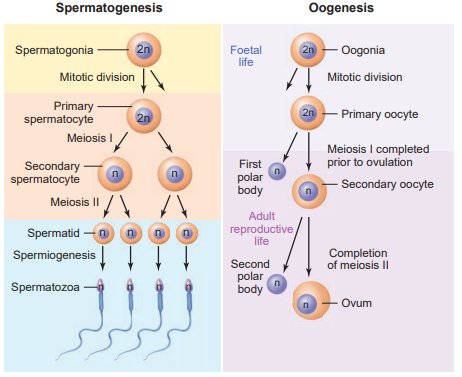
3.Draw a schematic representation of spermatogenesis and oogenesis in humans. (2)
4.How does the body organs develop from the primary germ layers? (2)
Development of Body Organs from Primary Germ Layers (3 Marks)
- The primary germ layers (ectoderm, mesoderm, endoderm) give rise to all body organs.
1. Ectoderm
- Forms:
- Central nervous system (brain, spinal cord)
- Peripheral nervous system
- Epidermis and its derivatives
- Mammary glands
2. Mesoderm
- Forms:
- Connective tissues, cartilage, bone
- Muscles
- Urinogenital organs (kidney, ureter, gonads)
3. Endoderm
- Forms:
- Epithelium of digestive and respiratory tracts
- Liver, pancreas
- Thyroid and parathyroid glands
FIVE MARKS
1.What is menstrual cycle? Explain the various phases of the menstrual cycle. (6)
Definition
- The menstrual cycle is a series of cyclic changes in the ovary and uterus occurring every 28–29 days during the reproductive life of females (from menarche to menopause).
- It involves periodic changes in the endometrium and indicates normal reproductive function.
Phases of Menstrual Cycle
1. Menstrual Phase (3–5 days)
- Shedding of endometrial lining with blood flow
- Caused by decrease in progesterone and oestrogen
- Occurs if fertilization does not take place
2. Follicular / Proliferative Phase (Day 5–14)
- A primary follicle develops and matures into a Graafian follicle.
- Endometrium regenerates and thickens
- Controlled by FSH and LH
- Increased oestrogen secretion
3. Ovulatory Phase (Around Day 14)
- LH surge causes rupture of Graafian follicle
- Release of ovum (ovulation)
4. Luteal / Secretory Phase (Day 15–28)
- Formation of corpus luteum
- Secretes progesterone to maintain endometrium
- Prepares uterus for implantation
- If fertilization occurs:
- Endometrium maintained → pregnancy
- If no fertilization:
- Corpus luteum → corpus albicans
- Endometrium breaks down → next menstruation
Conclusion
- Cycle repeats every 28 days
- Controlled by hormones (FSH, LH, oestrogen, progesterone)
2.Define Oogenesis, Explain the structure of Ovum with diagram.(3)
Definition
- Oogenesis is the process of formation and development of the female gamete (ovum) in the ovaries.
Process of Oogenesis (Brief)
- During foetal development, oogonia are formed by mitosis
- Oogonia develop into primary oocytes and get arrested in Prophase I
- Each primary oocyte is surrounded by granulosa cells to form a primary follicle
- Many follicles degenerate; only few remain at puberty
Structure of Ovum
- Human ovum is:
- Non-cleidoic (without shell)
- Alecithal (very little yolk)
- Microscopic
Parts:
- Ooplasm → Cytoplasm of ovum
- Germinal vesicle → Nucleus
Coverings (3 layers):
- Vitelline membrane
- Inner thin, transparent layer
- Zona pellucida
- Middle thick layer
- Corona radiata
- Outer layer of follicular cells
- Perivitelline space:
- Space between vitelline membrane and zona pellucida
3.List the various menstrual disorders.(2) Nill (Not for Biology)
1. Amenorrhoea
- Absence of menstruation
- Primary amenorrhoea → Menarche not attained till 18 years
- Secondary amenorrhoea → Absence of menstruation for more than 3 months
2. Polymenorrhoea
- Short menstrual cycle (< 21 days)
- Causes:
- Hormonal imbalance (pituitary hyperactivity)
- Psychological stress, malnutrition
- Infections (e.g., STDs)
3. Dysmenorrhoea
- Painful menstruation
- Types:
- Primary → Due to prostaglandins (no disease)
- Secondary → Due to disorders (endometriosis, fibroids)
4. Menorrhagia
- Heavy and prolonged menstrual bleeding
- Causes:
- Hormonal imbalance
- Uterine fibroids
- Ovarian dysfunction
- Sometimes cancers (uterus, ovary, cervix)
5. Oligomenorrhoea
- Infrequent menstruation (> 35 days gap)
- Occurs in women of reproductive age
