
📚 12th Chemistry Most Repeated Questions – Tamil Nadu Board 2026
💡 12th Chemistry Top 20 Five Marks Public exam 2026
💡 12th Chemistry Top 30 Three Marks Public exam 2026
💡 12th Chemistry Top 50 Two Marks Public exam 2026
💡 12th Chemistry Important Compulsory Questions Public exam 2026
💡 12th Chemistry Score Centum plan 2026
💡 12th Chemistry Additional 2,3 & 5 Mark Questions(New)
Book Back Questions
- Ln11 : Q19 , 20
- Ln12 : Q2 5 Mark, Q5 3 Mark
- Ln13 : Q5(All) || 6th subdivision very important (Ph Based Question)
- Ln13 : Electrophilic substitution reaction(Imp) see other properties in box
Book Inside Questions
5 Marks
Q1.A compound ‘A’ of molecular formula C₂H₃N on reduction with Na(Hg)/C₂H₅OH gives ‘B’ of molecular formula C₂H₇N which undergoes carbylamine test. Compound ‘B’ on reaction with nitrous acid gives compound ‘C’ of molecular formula C₂H₆O by liberating nitrogen. Identify A, B and C and write the reactions involved. (Repeating)
Answer:
- A = Acetonitrile (CH₃CN)
- B = Ethylamine (C₂H₅NH₂)
- C = Ethanol (C₂H₅OH)
Reason:
- Compound B gives carbylamine test, so it must be a primary amine. Hence B = Ethylamine.
- Primary amine reacts with nitrous acid to give alcohol with liberation of N₂ gas, so C = Ethanol.
- The compound A (C₂H₃N) which on reduction gives ethylamine is acetonitrile.
Reactions involved:
- Reduction:
CH₃CN + 4[H] → CH₃CH₂NH₂
(Acetonitrile) (Ethylamine)
Reagent: Na(Hg) / C₂H₅OH
- Reaction with nitrous acid:
CH₃CH₂NH₂ + HNO₂ → CH₃CH₂OH + N₂ ↑ + H₂O
(Ethylamine) (Ethanol)
Thus, A = CH₃CN (Acetonitrile), B = C₂H₅NH₂ (Ethylamine), C = C₂H₅OH (Ethanol).
Q2.An organic compound A with molecular formula C₇H₆O reduces Tollens’ reagent but does not reduce Fehling’s solution. A reacts with 50% NaOH to give B and C. C on treatment with soda lime gives D. Identify A, B, C and D. Write the equations.
Answer:
- A = Benzaldehyde (C₆H₅CHO)
- B = Benzyl alcohol (C₆H₅CH₂OH)
- C = Sodium benzoate (C₆H₅COONa)
- D = Benzene (C₆H₆)
Reason:
- Compound A reduces Tollens’ reagent but not Fehling’s solution, which indicates it is an aromatic aldehyde. Hence A = Benzaldehyde.
- Benzaldehyde with 50% NaOH undergoes Cannizzaro reaction producing benzyl alcohol and sodium benzoate.
- Sodium benzoate on heating with soda lime undergoes decarboxylation to form benzene.
Reactions involved:
- Cannizzaro reaction:
2C₆H₅CHO + NaOH → C₆H₅CH₂OH + C₆H₅COONa
(Benzaldehyde) (Benzyl alcohol) (Sodium benzoate)
- Decarboxylation with soda lime:
C₆H₅COONa + NaOH → C₆H₆ + Na₂CO₃
(Sodium benzoate) (Benzene)
Thus, A = Benzaldehyde, B = Benzyl alcohol, C = Sodium benzoate and D = Benzene.
Q3.An organic compound C₃H₄ (A) on hydrolysis with Hg²⁺ / H₂SO₄ gives compound (B) which gives positive iodoform test. Compound (B) heated with NH₂–NH₂ / C₂H₅ONa gives hydrocarbon (C). (B) also treated with methanal in the presence of dil. NaOH gives compound C₄H₈O₂ (D). Identify A, B, C and D. Write the chemical reactions involved.
Answer
- A = Propyne (CH₃–C≡CH)
- B = Acetone / Propanone (CH₃COCH₃)
- C = Propane (C₃H₈)
- D = 3-Hydroxy-2-methylpropanal (C₄H₈O₂)
Reason
- Hydrolysis of terminal alkyne (Kucherov reaction):
Alkyne C₃H₄ with Hg²⁺ / H₂SO₄ forms a ketone.
Propyne gives acetone, which gives positive iodoform test (methyl ketone). - Wolff–Kishner reduction:
Ketone on heating with NH₂NH₂ / C₂H₅ONa reduces C=O → CH₂, forming an alkane. - Crossed Aldol reaction:
Acetone reacts with methanal in dilute NaOH to form a β-hydroxy aldehyde.
Reactions
1. Hydrolysis (Kucherov reaction):
CH₃–C≡CH + H₂O
Hg²⁺ / H₂SO₄
→ CH₃COCH₃ (Acetone)
2. Wolff–Kishner reduction:
CH₃COCH₃ + NH₂NH₂
C₂H₅ONa / heat
→ CH₃CH₂CH₃ (Propane) + N₂ + H₂O
3. Aldol reaction:
CH₃COCH₃ + HCHO
dil. NaOH
→ CH₃COCH₂CH₂OH → C₄H₈O₂ (β-hydroxy carbonyl compound)
3 & 2 Marks
Q1.CH₃COCl + H₂ —Pd/BaSO₄→ A —NaOH→ B —Δ→ C
Identify A, B and C.
Answer :
- A = Ethanal (CH₃CHO)
- B = 3-Hydroxybutanal
- C = Crotonaldehyde (CH₃CH=CHCHO).
Reason:
This reaction involves Rosenmund reduction followed by reactions with NaOH.
- First step (Rosenmund reduction):
CH₃COCl + H₂ —Pd/BaSO₄→ CH₃CHO
So,
A = Ethanal (CH₃CHO)
- Second step (reaction with NaOH – Aldol reaction):
2 CH₃CHO —NaOH→ CH₃CH(OH)CH₂CHO
So,
B = 3-Hydroxybutanal (Aldol)
- Third step (heating / dehydration):
CH₃CH(OH)CH₂CHO —Δ→ CH₃CH=CHCHO
So,
C = Crotonaldehyde (But-2-enal)
Q2.An organic compound (A) – C₃H₈O₃ used as a sweetening agent, on oxidation with Fenton’s reagent (H₂O₂ / Fe²⁺) gives a mixture of compounds B and C. Identify A, B and C. Write possible reactions.
Answer
- A = Glycerol (Propane-1,2,3-triol)
- B = Glyceraldehyde
- C = Dihydroxyacetone
Reason
The molecular formula C₃H₈O₃ and use as a sweetening agent indicate glycerol.
On oxidation with Fenton’s reagent, glycerol undergoes oxidation of alcohol groups forming glyceraldehyde and dihydroxyacetone.
Reactions
1. Oxidation to glyceraldehyde
HO–CH₂–CHOH–CH₂OH
(H₂O₂ / Fe²⁺)
→ HO–CH₂–CHOH–CHO
(Glyceraldehyde)
2. Oxidation to dihydroxyacetone
HO–CH₂–CHOH–CH₂OH
(H₂O₂ / Fe²⁺)
→ HO–CH₂–CO–CH₂OH
(Dihydroxyacetone)
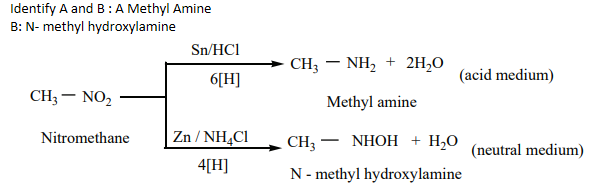
Q3.In the following Question A : is Methyl Amine & B N- Methyl hydroxylamine (It wil be blank in the questions)
Q4.A (C₂H₅NO) —(Br₂ / KOH)→ CH₅N (B). Identify A and B and write the reaction.
Answer
- A = Acetamide (CH₃CONH₂)
- B = Methylamine (CH₃NH₂)
Reason
The reagent Br₂ / KOH indicates the Hofmann bromamide reaction, where an amide loses one carbon atom and forms a primary amine.
Thus acetamide (C₂H₅NO) gives methylamine (CH₃NH₂).
Reaction
CH₃CONH₂ + Br₂ + 4KOH
→ CH₃NH₂ + K₂CO₃ + 2KBr + 2H₂O
Q4.Identify A and B
A → (Na(Hg) / C₂H₅OH) → CH₃–CH₂–NH₂
B → (Na(Hg) / C₂H₅OH) → CH₃–NH–CH₃
Answer:
- A = CH₃–C≡N (Acetonitrile / Methyl cyanide)
- B = CH₃–N≡C (Methyl isocyanide)
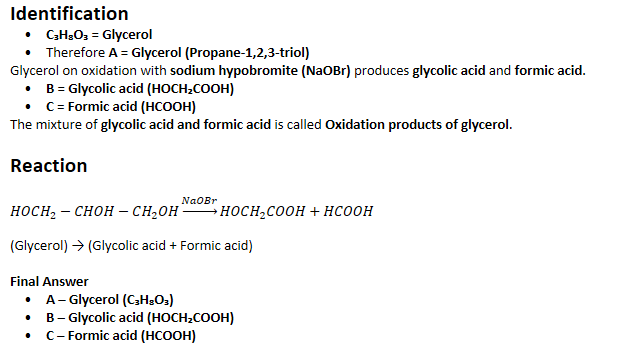
Q5.Compound (A) → C₃H₈O₃ oxidised with sodium hypobromite to give a mixture of compounds (B) and (C). Identify A, B and C. Write the possible reactions. Name the mixture of (B) and (C).
Q6.Phenol is distilled with Zn dust gives compound A. A reacts with propene gives compound B, which on air oxidation gives compound C. Identify A, B and C.
Answer:
- A = Benzene (C₆H₆)
- B = Cumene (Isopropyl benzene)
- C = Phenol
Reactions:
- Phenol + Zn → Benzene + ZnO
- Benzene + Propene → Cumene
(Friedel–Crafts alkylation) - Cumene + O₂ → Cumene hydroperoxide → Phenol + Acetone
Q7.Phenol is distilled with Zn dust gives compound A. A reacts with propene gives compound B, which on air oxidation gives compound C. Identify A, B and C.
Answer:
- A = Benzene (C₆H₆)
- B = Cumene (Isopropyl benzene)
- C = Phenol (C₆H₅OH)
Reason:
- Phenol on distillation with Zn dust forms benzene.
- Benzene + propene gives cumene (isopropyl benzene).
- Cumene on air oxidation forms phenol (cumene process).
Reactions:
- C₆H₅OH + Zn → C₆H₆ + ZnO
- C₆H₆ + CH₃–CH=CH₂ → C₆H₅–CH(CH₃)₂ (Cumene)
- Cumene + O₂ → Cumene hydroperoxide → C₆H₅OH (Phenol) + Acetone.
Q8.Ethanoic acid —(SOCl₂)→ A —(Pd/BaSO₄)→ B. Identify A and B.
Answer:
- A = Acetyl chloride (CH₃COCl)
- B = Ethanal (CH₃CHO)
Reactions:
- CH₃COOH + SOCl₂ → CH₃COCl + SO₂ + HCl
- CH₃COCl + H₂ —Pd/BaSO₄→ CH₃CHO (Ethanal)
Q.9

Answer:
- A = Aniline (C₆H₅NH₂)
- B = Benzene diazonium chloride (C₆H₅N₂⁺Cl⁻)
- C = Phenol (C₆H₅OH)
Reactions:
- Reduction of nitrobenzene:
C₆H₅NO₂ + 6[H] —Fe/HCl→ C₆H₅NH₂ + 2H₂O - Diazotization:
C₆H₅NH₂ + NaNO₂ + HCl (273 K) → C₆H₅N₂⁺Cl⁻ + 2H₂O - Hydrolysis:
C₆H₅N₂⁺Cl⁻ + H₂O (283 K) → C₆H₅OH + N₂ + HCl
