
12th Chemistry Chapter 1 – 5 Mark Questions (Important & Repeated – TN Board)
12th Chemistry Metallurgy
Prepare for the Tamil Nadu Class 12 Chemistry Public Examination with carefully selected Chapter 1 – Metallurgy Important 5 Mark Questions. These chapter-wise questions are compiled from the last six years of 1st Mid-Term, Quarterly, 2nd Mid-Term, Half-Yearly, Revision Exam 1, Revision Exam 2, and Tamil Nadu State Board Public Examination question papers to help students revise effectively and score high marks.
01
Chapter Number
5 Marks
50+ Question Papers
TN Board
Latest Syllabus
Most Repeated 5 Mark Questions
Curated from Previous Year Question Papers
1.Explain the principle of electrolytic refining with an example?(5)
The crude metal is refined by electrolysis, It is carried out in an electrolytic cell.
Anode : The rods of impure metal
Cathode : Thin strips of pure metal are used as cathode
Electrolyte : Aqueous solution of the salts of the metal.
The metal of interest dissolves from the anode, pass into the solution while the same amount of metal ions from the solution will be deposited at the cathode. During electrolysis, the less electropositive impurities in the anode, settle down at the bottom and are removed as anode mud.
Electrolytic refining of silver
- Cathode : Pure silver
- Anode : Impure silver rods
- Electrolyte : Acidified aqueous solution of silver nitrate.
When a current is passed through the electrodes the following reactions will take place
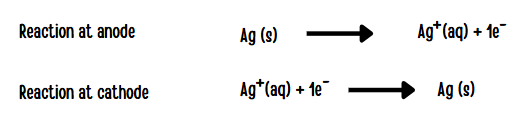
During electrolysis, at the anode the silver atoms lose electrons and enter the solution. The positively charged silver cations migrate towards the cathode and get discharged by gaining electrons and deposited on the cathode.
Other metals such as copper, zinc etc.,can also be refined by this process in a similar manner
2.Explain the method of froth floatation(4)
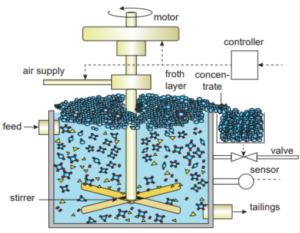
- This method is commonly used to concentrate sulphide ores such as galena (PbS), zinc blende (ZnS) etc
- The metallic ore particles which are wetted by oil can be separated from gangue.
- In this method, the crushed ore is suspended in water and mixed with frothing agent such as pine oil, eucalyptus oil etc.
- A small quantity of sodium ethyl xanthate which acts as a collector is also added.
- A froth is generated by blowing air through this mixture.
- The collector molecules attach to the ore particle and make them water repellent.
- As a result, ore particles, wetted by the oil, rise to the surface along with the froth.
- The froth is skimmed off and dried to recover the concentrated ore.
- The gangue particles that are preferentially wetted by water settle at the bottom.
3.Explain gravity separation?(3)
- In this method, the ore having high specific gravity is separated from the gangue that has low specific gravity by simply washing with running water.
- Ore is crushed to a finely powdered form and treated with rapidly flowing current of water.
- During this process the lighter gangue particles are washed away by the running water.
- This method is generally applied to concentrate the native ore such as gold and oxide ores such as haematite (Fe O ), tin stone (SnO ) etc.
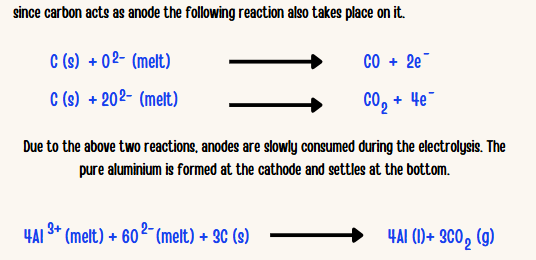
4.Explain the electro metallurgy of alluminium? or Hall-Heroult method?(3)
Cathode : Iron tank lined with carbon.
Anode : The carbon blocks.
Electrolyte: A 20% solution of alumina, obtained from the bauxite ore is mixed with molten cryolite.
- About 10% calcium chloride is also added to the solution. Here calcium chloride helps to lower the melting point of the mixture
Temperature : Above 1270 K

What’s Next?
Continue your journey through Lesson 1 – Metallurgy. Master the important Two Mark and Three Mark questions, or explore the complete 12th Metallurgy study guide covering every chapter.
12th Chemistry Chapter 1 Metallurgy Important 5 Marks Questions
Welcome to our collection of 12th Chemistry Chapter 1 Metallurgy Important 5 Marks Questions and Answers prepared from previous year public question papers and important board exam questions. These questions are highly useful for Tamil Nadu State Board students preparing for public examinations, school tests, revision exams, and competitive examinations.
The chapter Metallurgy is one of the most important units in Class 12 Chemistry. It contains several theory-based long answer questions that are frequently asked in Tamil Nadu public examinations. Practicing these important 5 mark questions helps students understand the concepts clearly and improve answer writing skills.
Important 5 Mark Questions Covered
- Explain the principle of electrolytic refining with an example
- Explain the method of froth floatation
- Explain gravity separation
- Explain the electrometallurgy of aluminium
- Hall-Heroult Process
Benefits of Practicing 5 Mark Questions
- Improves detailed answer writing
- Helps score full marks in long answers
- Strengthens conceptual understanding
- Useful for public exam revision
- Enhances presentation and explanation skills
Previous Year Public Exam Important Questions
The important 5 mark questions provided here are collected from previous year Tamil Nadu 12th Chemistry public question papers and important repeated board exam questions. These long answer questions are often asked directly or indirectly in public examinations.
Students should practice writing answers with proper headings, diagrams, equations, and step-by-step explanations to secure maximum marks in the board examination.
More 12th Chemistry Study Materials
Explore more useful study resources for Class 12 Chemistry:
- Important 1 Mark Questions
- 2 Marks, 3 Marks and 5 Marks Questions
- Book Back Answers
- Chapter Wise Notes
- Most Expected Questions
- Public Exam Study Materials
- Previous Year Question Papers with Answers
Regular practice of important questions from Metallurgy can help students gain confidence and score high marks in the 12th Chemistry public examination.
