
12th Physics Electrostatics
Prepare for the Tamil Nadu 12th Physics Public Examination with carefully selected Chapter 1 – Electrostatics Important 3 Mark Questions. These chapter-wise questions are compiled from the last six years of 1st Mid-Term, Quarterly, 2nd Mid-Term, Half-Yearly, Revision Exam 1, Revision Exam 2, and Tamil Nadu Public Examination question papers.
01
Chapter Number
3 Marks
50+ Question Papers
TN Board
Latest Syllabus
Most Repeated 3 Mark Questions
Curated from Previous Year Question Papers
1.Obtain the expression for energy stored in a parallel plate capacitor?(6)
When a battery is connected to a capacitor, electrons of total charge −Q are transferred from one plate to another. Work is done by the battery to transfer the charge. This work is stored as electrostatic potential energy in the capacitor.
To transfer an infinitesimal charge dQ for a potential difference V, the work done is given by

Total work done


![= \frac{1}{C} \left[ \frac{q^{1+1}}{1+1} \right]](https://padidaa.com/wp-content/ql-cache/quicklatex.com-997c4088858b3a22498ea63d6a149aa4_l3.png "Rendered by QuickLaTeX.com")

This work done is stored as electrostatic potential energy (UE) in the capacitor.

![= \frac{C^2 V^2}{2C} \quad [Q = CV]](https://padidaa.com/wp-content/ql-cache/quicklatex.com-5861f97b84704bc59b5fa56e2e2f1386_l3.png "Rendered by QuickLaTeX.com")





Ad = volume of the space between the capacitor plates
The energy stored per unit volume of space is defined as energy density



It is important to note that the energy density depends only on the electric field and not on the size of the plates of the capacitor.
2.Derive an expression for electrostatic potential due to a point charge?(3)
Consider a positive charge q kept fixed at the origin.Let P be a point at distance r from the charge q.
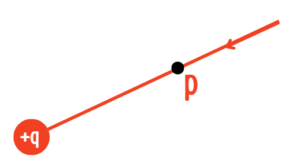




![= - \frac{q}{4\pi \varepsilon_0} \left[ \frac{r^{-2+1}}{-2+1} \right]_{\infty}^{r}](https://padidaa.com/wp-content/ql-cache/quicklatex.com-9026eb5891b6d6a6d5938226c38e1073_l3.png "Rendered by QuickLaTeX.com")
![= - \frac{q}{4\pi \varepsilon_0} \left[ \frac{r^{-1}}{-1} \right]_{\infty}^{r}](https://padidaa.com/wp-content/ql-cache/quicklatex.com-9253dc4a9d93fa4f6583215d70814061_l3.png "Rendered by QuickLaTeX.com")
![= \frac{q}{4\pi \varepsilon_0} \left[ \frac{1}{r} \right]_{\infty}^{r}](https://padidaa.com/wp-content/ql-cache/quicklatex.com-9a79df302c0e90deab295c1819b82973_l3.png "Rendered by QuickLaTeX.com")


The electric potential due to a point charge q at a distance r is
3.Obtain the expression for capacitance for a parallel plate capacitor?(2)
Consider a capacitor with two parallel plates each of cross- sectional area A and separated by a distance d , The electric field between two infinite parallel plates is uniform and is given by
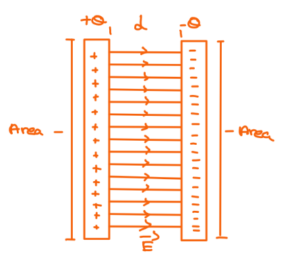




Now Electric potential
![V = Ed \quad [\text{distance between plates}]](https://padidaa.com/wp-content/ql-cache/quicklatex.com-fa694a9c169b108c9c44046ba6d1c321_l3.png "Rendered by QuickLaTeX.com")

sub V in (1)



it is evident that capacitance is directly proportional to the area of cross section and is inversely proportional to the distance between the plates.
4.Derive the expression for resultant capacitance,when capacitors are connected in series?(2)
- Consider three capacitors of capacitance C1 ,C2 and C3 connected in series with a battery of voltage V .
- As soon as the battery is connected to the capacitors in series, the electrons of charge –Q are transferred from negative terminal to the right plate of C3
- which pushes the electrons of same amount –Q from left plate of C3 to the right plate of C2 due to electrostatic induction.
- Similarly, the left plate of C2 pushes the charges of –Q to the right plate of C1 which induces the positive charge +Q on the left plate of C1 .
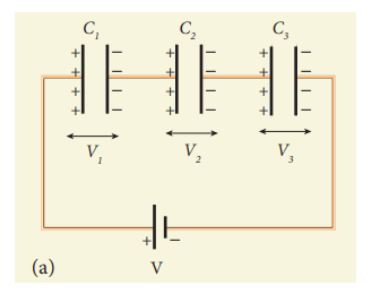
The sum of the voltages across the capacitor must be equal to the voltage of the battery.

Since, Q = CV, we have , V = Q/C

If three capacitors in series are considered to form an equivalent single capacitor Cs



This equivalent capacitance Cs is always less than the smallest individual capacitance in the series.
5.Derive the expression for resultant capacitance,when capacitors are connected in parallel?(2)
- Capacitors of capacitance C1 , C2 and C3 connected in parallel with a battery of voltage V
- The voltage across each capacitor is equal to the battery’s voltage
- Let the charge stored in the three capacitors be Q1 , Q2, and Q3 respectively. According to the law of conservation of total charge, the sum of these three charges is equal to the charge Q transferred by the battery,
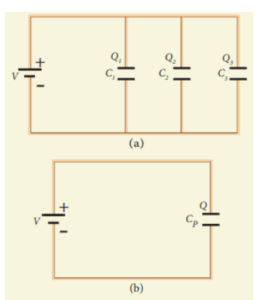



If these three capacitors are considered to form a single equivalent capacitance C_P


- Thus, the equivalent capacitance of capacitors connected in parallel is equal to the sum of the individual capacitances.
- The equivalent capacitance CP in a parallel connection is always greater than the largest individual capacitance.
6.Give the applications and disadvantages of capacitor or uses of capacitor? (2)
Applications :
- (a) Flash capacitors are used in digital cameras for taking photographs. The flash which comes from the camera when we take photographs is due to the energy released from the capacitor, called a flash capacitors.
- (b) During cardiac arrest, a device called heart defibrillator is used to give a sudden surge of a large amount of electrical energy to the patient’s chest to retrieve the normal heart function.
- (c) Capacitors are used in the ignition system of automobile engines to eliminate sparking.
- (d) Capacitors are used to reduce power fluctuations in power supplies and to increase the efficiency of power transmission.
Disadvantage :
Even after the battery or power supply is removed, the capacitor stores charges and energy for some time. For example if the TV is switched off, it is always advisable to not touch the back side of the TV panel.
Appeared Once Questions
Curated from Previous Year Question Papers
1.Various properties of conductors in electrostatic equilibrium?
- (i) The electric field is zero everywhere inside the conductor. This is true regardless of whether the conductor is solid or hollow.
- (ii) There is no net charge inside the conductors. The charges must reside only on the surface of the conductors.
- (iii) The electric field outside the conductor is perpendicular to the surface of the conductor and has a magnitude of

- (iv) The electrostatic potential has the same value on the surface and inside of the conductor.
2.Differences between coulomb force and gravitational force?
| Gravitational force | Coulomb force |
|---|---|
| The gravitational force between two masses is always attractive | Coulomb force between two charges can be attractive or repulsive, depending on the nature of charges. |
| The gravitational force between two masses is independent of the medium. | Electrostatic force between the two charges depends on nature of the medium in which the two charges are kept at rest. |
| The value of gravitationa constant G = 6.67 x 10⁻¹¹ Nm2kg-2 | The value of constant k in coloumb law is k = 9×10⁹ Nm2c-2 . Since k is much more greater than G. The electrostatic force is always greater in magnitute than gravitational force for smaller objects |
What’s Next?
Continue your journey through Lesson 1 – Electrostatics. Master the important Five Mark and Two Mark questions, or explore the complete 12th Physics study guide covering every chapter.
⭐ Why Thousands of Students Choose Padidaa
✔ Carefully Curated Previous Year Questions
✔ Chapter-wise Important 2, 3 & 5 Mark Questions
✔ Book Back Questions with Answers
✔ Public Exam Focused Study Material
✔ Free Online Notes & PDF Downloads
✔ Updated for the Latest Tamil Nadu Board Syllabus
