
12th Physics Current Electricity
Prepare for the Tamil Nadu 12th Physics Public Examination with carefully selected Chapter 2 – Current Electricity Important 5 Mark Questions. These chapter-wise questions are compiled from the last six years of 1st Mid-Term, Quarterly, 2nd Mid-Term, Half-Yearly, Revision Exam 1, Revision Exam 2, and Tamil Nadu Public Examination question papers.
02
Chapter Number
Five Marks
50+ Question Papers
TN Board
Latest Syllabus
Most Repeated 5 Mark Questions
Curated from Previous Year Question Papers
1.Obtain the relation between current and drift velocity? or Microscopic model of current? (7)
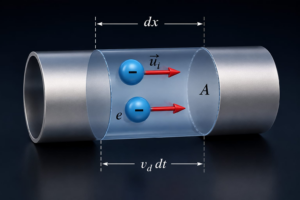
Consider a conductor with area of cross section and let an electric field be applied to it from right to left. Suppose there are n electrons per unit volume in the conductor and assume that all the electrons move with the same drift velocity ,
Current,
Total Charge
Drift Velocity
Electrons available in volume of length
dQ=e(Avddt)n
Current,
Substituting ,
Cancelling ,
This is the relationship between current & Drift Velocity
Current density is defined as the current flowing per unit area.
Substituting
SI unit of current density:
In Vector Form
We know that,
Let,
where is called conductivity.
Therefore,
This equation is called the microscopic form of Ohm’s law.
2.Comparison of emf of two cells with a potentiometer ?(6)
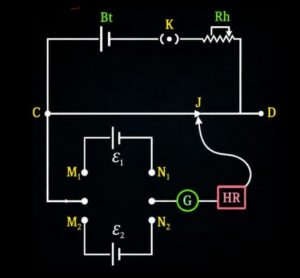
- The positive terminals of , , and are connected to the same end .
- To compare the emf of two cells, a potentiometer arrangement is used.
- The potentiometer wire is connected to a battery and key in series. This forms the primary circuit.
- The ends and are connected to a DPDT (Double Pole Double Throw) switch.
- The cells with emf and are connected to terminals and respectively.
- A galvanometer , high resistance , and jockey are connected in the secondary circuit.
Procedure
- The DPDT switch is pressed towards so that the cell is included in the secondary circuit.
- The jockey is moved along the potentiometer wire to obtain zero deflection in the galvanometer.
- The balancing length obtained is .
- Similarly, the switch is pressed towards to include the second cell .
- The balancing length is obtained for zero deflection.
If is the resistance per unit length of the potentiometer wire and I is the current through the wire, then potential gradient is,
For first cell,
For second cell,
Dividing equation (1) by equation (2),
Result
The ratio of emfs of two cells is equal to the ratio of their balancing lengths.
By including a rheostat (Rh) in the primary circuit, the experiment can be repeated several times by changing the current flowing through it.
3.Obtain the condition for bridge balance in Wheatstone’s bridge (5)
- Wheatstone’s bridge is an important application of Kirchhoff’s rules.
- It is used to compare resistances and in determining the unknown resistance in electrical network.
- The bridge consists of four resistances , , and connected as shown in the circuit.
- A galvanometer is connected between the points and .
- The battery is connected between the points and .
- The current through the galvanometer is and its resistance is .
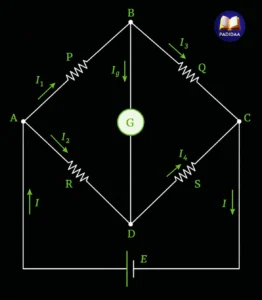
Kirchhoff Current Rule at B & D
Kirchhoff’s Voltage Rule
Substituting ,
From (1),
From (2),
From (3),
Substituting in (4),
Dividing equation (5) by equation (6),
Since,
This is the condition for bridge balance. Only under this condition, galvanometer shows null deflection. Suppose we know the values of two adjacent resistances, the other two resistances can be compared. If three of the resistances are known, the value of unknown resistance (fourth one) can be determined.
4.Explain the determination of unknown resistance using meter bridge (2)
- The meter bridge is another form of Wheatstone’s bridge.
- It consists of a uniform wire of manganin of one meter length.
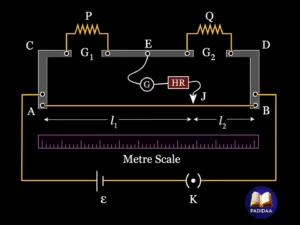
- This wire is stretched along a metre scale on a wooden board between two copper strips and .
- Between these two copper strips another copper strip is mounted to enclose two gaps and .
- An unknown resistance is connected in and a standard resistance is connected in .
- A jockey (conducting wire-contact maker) is connected to the terminal on the central copper strip through a galvanometer and a high resistance .
- A Leclanche cell and a key are connected between the ends of the bridge wire.
- The position of the jockey on the wire is adjusted so that the galvanometer shows zero deflection.
- Let the position of jockey on the wire be at .
- The resistances corresponding to and of the bridge wire form the resistances and of the Wheatstone’s bridge.
- Then, for bridge balance,
To find the specific resistance of the material of the wire in the coil P, the radius a and length l of the wire are measured.
The specific resistance or resistivity can be calculated using the relation,
By rearranging the above equation,
If is the unknown resistance, equation becomes,
5.Internal resistance of a cell using Potentiometer ? (1)
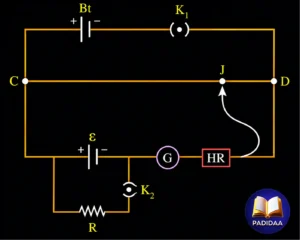
- To measure the internal resistance of a cell, the circuit connections are made using a potentiometer arrangement.
- The end of the potentiometer wire is connected to the positive terminal of the battery .
- The negative terminal of the battery is connected to the end through a key . This forms the primary circuit.
- The positive terminal of the cell of emf , whose internal resistance is to be determined, is also connected to the end of the wire.
- The negative terminal of the cell ε is connected to a jockey through a galvanometer and a high resistance.
- A resistance box and key are connected across the cell . With open, the balancing point is obtained and the balancing length is measured.
- Since the cell is in open circuit, its emf is measured.
ε=l1
The current passing through the cell and resistor is
Potential difference across
When potentiometer is balanced
Substituting ,
Substituting the values of the R, l1 and l2, the internal resistance of the cell is determined. The experiment can be repeated for different values of R. It is found that the internal resistance of the cell is not constant but increases with increase of external resistance connected across its terminals.
What’s Next?
Continue your journey through Lesson 2 – Current Electricity. Master the important Two Mark and Three Mark questions, or explore the complete 12th Physics study guide covering every chapter.
⭐ Why Thousands of Students Choose Padidaa
✔ Carefully Curated Previous Year Questions
✔ Chapter-wise Important 2, 3 & 5 Mark Questions
✔ Book Back Questions with Answers
✔ Public Exam Focused Study Material
✔ Free Online Notes & PDF Downloads
✔ Updated for the Latest Tamil Nadu Board Syllabus
